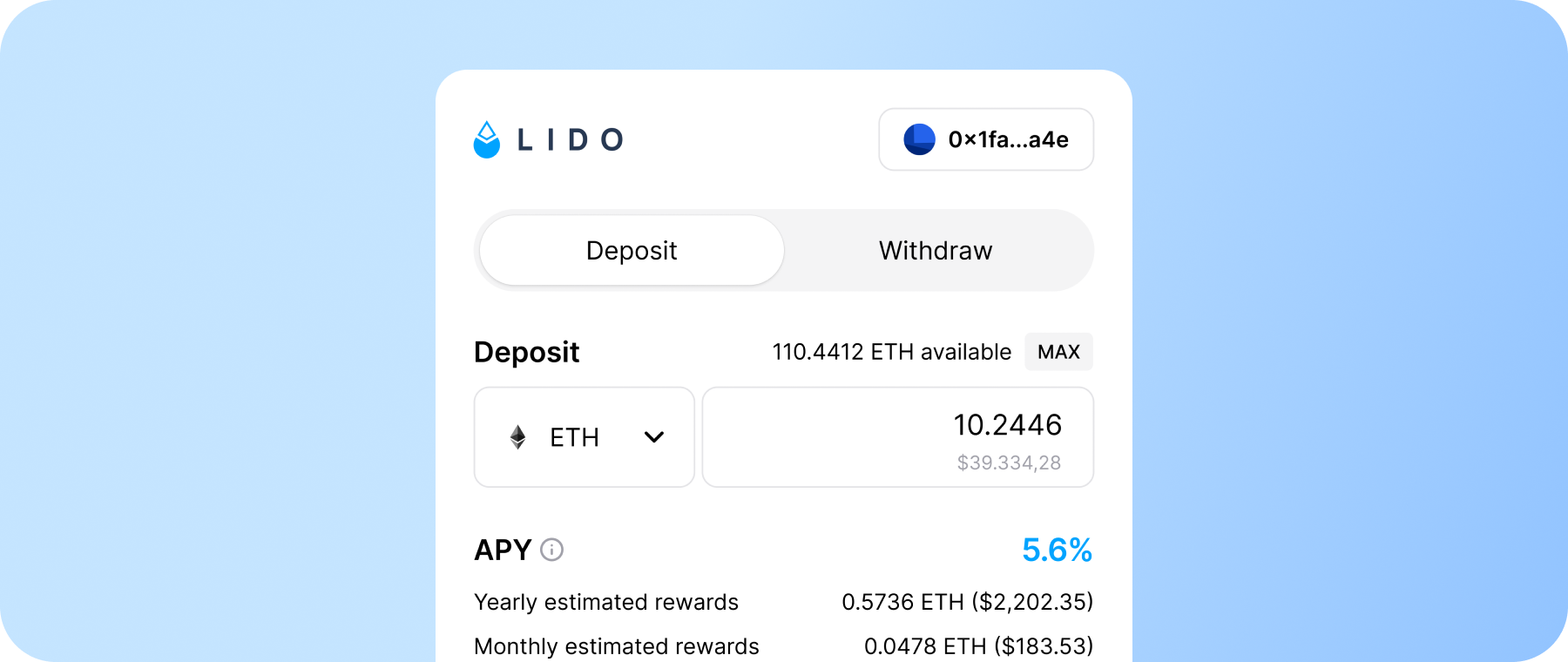
The DeFi Wrapper is a toolkit that enables builders, operators, and platforms to launch user-facing staking products powered by stVaults with optional automated rewards-boosting strategies.
While stVaults are single-owner, single-operator contracts by design, many practical use cases require pooled access with multiple users depositing into a single staking setup managed by an operator. The DeFi Wrapper addresses this by providing pre-built modules for pooled staking on top of stVaults.
Product Archetypes
Pooled Delegated Staking: Multiple users stake ETH with the same operator and earn APR from validator performance. Users deposit ETH, receive stvToken shares representing their portion, and earn through share price appreciation. Suitable for end-user products with conservative, validation-based returns.
stvToken is a reward-bearing ERC-20 token that represents a user’s share in the vault’s pool. The tokens can be transferred, integrated into other DeFi protocols and redeemed for the underlying ETH through the DeFi Wrapper withdrawal queue.
Pooled Delegated Liquid Staking: The same pooled structure, but users can access stETH liquidity within the vault's reserve ratio. Useful for institution-facing products combining liquidity access with compliance features such as whitelisting.
Boosted APR: Higher risk and higher potential rewards through leverage strategies. Strategy adapters optimize capital deployment to generate returns above staking rewards. This creates more validator exposure than the original deposit amount. Custom DeFi strategies are also supported through the adapter interface.
Architecture
The DeFi Wrapper operates through four layers:
Deposits and Withdrawals: the DeFi Wrapper accepts ETH deposits, funds the underlying vault, and issues stvToken shares. A withdrawal queue manages exits, requiring fresh oracle reports and enforcing minimum delays.
stETH Wrapping: Enables liquidity access by minting stETH against stvToken positions, accounting for reserve ratio constraints.
Strategy Adapters: For boosted products, adapters deploy per vault-strategy-user combinations, enabling automated leverage or reward optimization through third-party lending protocols.
Utility Layer: Includes a web interface for end-users, a factory for single-transaction deployment, and CLI tools for operators.
Withdrawal Queue
All withdrawals proceed through a First In, First Out (FIFO) queue. Fresh oracle reports are required for processing, with a minimum one-day delay between request and finalization. If the share rate drops while a withdrawal is being processed, it is settled at the dropped rate, ensuring that users in the queue share any losses occurred during processing.
Rewards
Staking rewards flow through oracle reports and are reflected in stvToken price appreciation.
Sidecar rewards are additional incentives from third-party protocols. They are handled through a RewardDistributor contract that allocates ERC20 tokens among DeFi Wrapper users based on their stvToken holdings.
Pause and Upgradability
DeFi Wrapper contracts support granular pausing of deposits, minting, withdrawals, and finalization. An emergency committee can pause any of these independently for immediate vulnerability response but cannot unpause. Resuming requires governance action through the timelock.
Risks
- Smart contract complexity: Additional contracts and interactions increase implementation complexity and expand the risk surface.
- Leverage risk: Leveraged strategies can be liquidated if the stETH/ETH ratio moves unfavorably.
- Oracle dependency: Reward accounting and withdrawal processing depend on fresh and correct oracle reporting.
- Liquidity constraints: Large withdrawals may require validator exits, which can delay settlement and increase execution risk.
- Strategy risk: External strategy adapters and third-party protocol integrations can introduce additional failure modes.
- Node operator risk: Operators affect deposits, finalization timing, and report freshness, which can impact user outcomes.
Mitigations include auditing, conservative health factors for leverage, quarantine periods for suspicious oracle values, strategy whitelisting, position limits, and the PredepositGuarantee for deposit protection.